Crypto risk notice
Digital assets and crypto software involve significant risk. Prices and token values are volatile, and you can lose everything you put in. This page covers NEAR Protocol for information only; it is not investment advice, an endorsement, or an offer to buy or sell any asset. Always do your own research before making financial decisions.
NEAR Is Becoming an Execution Layer for AI
Chain abstraction is the bigger story
By WhatAI Editorial ·
NEAR's second act is more interesting than its first
NEAR Protocol entered the market with a familiar Layer 1 promise: faster transactions, low fees, sharding, readable account names, and a development experience designed to feel less punishing than early Web3 infrastructure. That foundation still matters. But it is no longer the most useful way to understand the network in 2026.
The more consequential NEAR story now sits at the intersection of AI agents and chain abstraction. The network is being shaped into an execution layer where a person, application, or autonomous agent can describe an outcome, coordinate activity across several chains, and use private or verifiable compute without forcing the end user to understand every wallet, route, signature scheme, and gas token underneath.
That is a much larger ambition than being another fast smart-contract chain. It also creates a more demanding test. The technology has to make complex systems feel simpler without hiding the risks that remain. Solvers can fail. Cross-chain routes can introduce dependencies. Trusted Execution Environments have their own trust assumptions. Smart contracts and agents can still make expensive mistakes. NEAR is compelling because it is trying to organize these moving parts into one coherent stack, not because it makes them disappear.
What NEAR actually provides
At the base is a proof-of-stake blockchain built around Nightshade sharding. The official documentation describes a sharded network that distributes state and processing across parallel shards, with blocks assembled from the chunks produced by those shards. For developers, contracts run as WebAssembly and Rust remains the primary contract language, while JavaScript, TypeScript, Python, and Go tooling broaden the ways teams can interact with the network.
NEAR's account model remains one of its most practical design decisions. Accounts can have readable names and multiple access keys with different permissions. A full-access key can control the account, while a function-call key can be limited to specific contracts, methods, and a gas allowance. That gives product teams more room to design familiar sign-in experiences and constrained application sessions. Meta transactions add another option: a relayer can pay the network fee for a signed user action, so the user does not necessarily need to hold NEAR before interacting with an application.
The cost model is usage based, not free. Normal transactions consume deterministic gas units and are paid in the NEAR token at the network's current gas price. The official developer home currently describes average transaction fees around $0.002, but that is a reference point rather than a guaranteed tariff. Dollar cost changes with the token price, the operation, and network conditions. Contracts also lock NEAR against the on-chain storage they occupy. That storage stake can be recovered when data is removed, but teams still need to plan working capital and storage growth.
This base layer is fast and inexpensive enough for frequent application actions, but the differentiating work happens above it.
Chain Signatures turn one account into a multichain controller
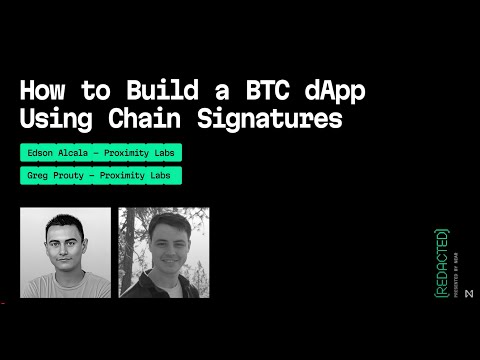
Chain Signatures allow a NEAR account or smart contract to request signatures for transactions on other blockchain networks. The system uses Multi-Party Computation, or MPC, so no single participating node holds the complete signing key. With a consistent derivation path, a NEAR account can control a corresponding address on a target chain and ask the MPC service to sign a prepared transaction.
The practical sequence matters. An application derives the foreign address, constructs a transaction in the format required by the destination chain, requests a signature through the NEAR contract, formats the returned signature, and then relays the signed transaction to that destination network. NEAR's documentation provides examples for Bitcoin, Solana, Cosmos, XRP, Aptos, Sui, and EVM networks. The underlying signature schemes can reach more chains, but every integration still needs the correct transaction construction, adapter logic, relaying, and operational testing.
This is not the same as moving wrapped assets through a conventional bridge. Chain Signatures can control native assets held at derived addresses on the destination chain. That can support a multichain wallet, cross-chain treasury, Bitcoin application, or agent that executes actions across several networks from logic coordinated on NEAR.
The distinction is valuable, but it should not be romanticized. Avoiding a wrapped asset bridge removes one class of custody and bridge-contract exposure. It does not eliminate risk. Developers are now depending on the MPC network, derivation-path discipline, destination-chain transaction logic, relayers, gas management, and their own authorization rules. A badly scoped contract can still request a valid signature for a harmful action. Security moves; it does not vanish.
NEAR Intents changes the interface from routes to outcomes
NEAR Intents approaches multichain activity from the user's desired result. Instead of asking a person or agent to choose every bridge, exchange, and intermediate asset, an intent expresses an outcome such as swapping one asset for another. Competing market makers, also called solvers, look for ways to fulfill it and return a quote for approval. Execution proceeds after the user or agent accepts the proposed solution.
That model is well suited to agentic software because agents naturally work from goals. An agent can ask for a target asset on a target chain without having to encode one fixed route for every market condition. The 1Click interface and related SDKs give developers a concrete integration path for cross-chain swaps, while the wider intents design points toward a marketplace for other outcomes.
The editorially important point is that an intent protocol is not an oracle of perfect execution. Quote quality depends on solver competition, available liquidity, supported assets, timing, and the constraints included in the request. A product still needs to show the user what will be received, which address and chain are involved, how long the quote remains valid, and what happens if a deposit arrives late or an execution leg fails. Slippage protection, minimum received amounts, refund paths, sanctions controls, and transaction monitoring are product requirements, not optional polish.
For an AI agent, the approval boundary becomes even more important. The agent may generate the intent, compare quotes, or prepare the action, but higher-value transfers should pass through explicit policy checks. Teams should cap value, restrict assets and destinations, require human confirmation above a threshold, and record the quote and authorization that led to execution. The easier the interface becomes, the more deliberate those invisible controls must be.
Why the AI layer is credible, and where it is still early
NEAR now presents itself as infrastructure for AI, not merely a blockchain that happens to host AI-themed applications. Its official stack includes tools that help coding agents read NEAR documentation, use task-specific skills, interact through an MCP endpoint, call on-chain functions, and access NEAR Intents. The broader NEAR AI offering focuses on private inference inside Trusted Execution Environments, with attestation intended to show that a protected workload ran in the expected environment.
This combination is coherent. An agent needs intelligence, private context, permissions, money, and a way to act. Confidential inference can protect prompts, data, or model execution from ordinary infrastructure exposure. NEAR accounts and access keys can constrain permissions. Intents can turn goals into proposed market actions. Chain Signatures can extend execution to external networks. The base chain can provide settlement, policy logic, and an auditable record.
Few infrastructure projects cover that full loop. It gives NEAR a plausible role in agent payments, multichain portfolio operations, autonomous services, private enterprise assistants, and machine-to-machine commerce.
But the phrase "verifiable AI" needs precision. TEE attestation can provide evidence about the hardware environment and deployed workload. It does not prove that a model's answer is true, safe, unbiased, or aligned with the user's intent. A securely executed hallucination is still a hallucination. A privately generated transaction can still be economically foolish. Applications must validate outputs, constrain tools, simulate transactions, and keep humans in the loop where consequences are material.
The same caution applies to autonomy. A demo that lets an agent trade across chains proves integration, not dependable judgment. Production teams need threat models for prompt injection, corrupted external data, key or session misuse, model drift, solver manipulation, and unexpected destination-chain behavior. The NEAR stack can provide useful primitives for those systems, but it does not replace application-level governance.
Where NEAR fits best
NEAR is strongest for teams building a product that combines several of its advantages rather than needing only a generic smart-contract host. A multichain wallet can use readable accounts, restricted keys, Chain Signatures, and sponsored transactions to reduce onboarding friction. A trading or payments interface can use Intents to hide route selection while retaining approval controls. An AI service can pair private inference with on-chain policy and cross-chain execution. A treasury product can coordinate actions from one NEAR contract while holding native assets on different networks.
It is also a reasonable base for consumer applications that value low transaction costs, quick finality, and familiar account experiences. The official documentation currently describes deterministic finality around 1.3 seconds and an average transaction fee near $0.002. Those characteristics support interactive products, although teams should benchmark their actual contract calls and avoid designing around marketing averages.
NEAR is less compelling when the application depends primarily on the deepest liquidity, largest developer labor pool, or most mature composability available in another ecosystem. Ethereum and its Layer 2 networks retain an enormous application and tooling surface. Solana offers a highly active environment for performance-sensitive consumer and trading products. Sui and Aptos provide object-oriented Move architectures that may suit particular asset models. Choosing NEAR should follow from its account design, chain abstraction, intent execution, or AI infrastructure, not from a generic belief that lower fees automatically win.
Teams should also separate using the protocol from taking exposure to its token. Developers need NEAR for gas, storage stake, and some operational flows. Validators and delegators use the token in network staking. None of that turns the token into a predictable investment, and token price can move independently of product adoption. Budget in token units and fiat equivalents, maintain gas reserves, and treat staking or treasury decisions as financial risk decisions rather than routine software configuration.
A practical evaluation path
Start with one narrow transaction flow. Build and test a standard NEAR account interaction before adding cross-chain or agent behavior. Use function-call keys wherever full account control is unnecessary, set allowances deliberately, and plan how a compromised session can be revoked. If users should not hold NEAR, test a relayer-backed meta-transaction path and decide who pays, rate-limits, and monitors that service.
For Chain Signatures, begin on testnets with a single destination network. Document the derivation path, transaction serialization, signature request, relaying process, gas funding, and recovery procedure. Treat adapters as security-critical code. Do not assume that support for a signature scheme means every destination-chain integration is production ready.
For Intents, request quotes without executing them first. Compare quoted output, expiry, fees, route completion time, and failure handling across realistic asset pairs. Then add explicit approval rules and transaction monitoring. An agent should receive a narrow tool that can propose or execute allowed actions, not an unrestricted private key and a vague instruction to optimize returns.
For private inference, verify what the attestation covers, which model is running, where data enters and leaves the trusted environment, and what logs or metadata remain outside it. Decide which outputs require deterministic checks or human review. Privacy and correctness are separate acceptance criteria.
Finally, test the whole experience under stress: stale quotes, insufficient destination gas, delayed signatures, relayer downtime, RPC failure, duplicate requests, cross-shard callbacks, and an agent proposing an action outside policy. The strongest architecture is not the one that works in the happy-path demo. It is the one that fails visibly, limits damage, and gives operators a clean recovery path.
The WhatAI verdict
NEAR's original usability thesis has matured into something more distinctive. Human-readable accounts and low fees are still useful, but they now support a broader architecture for agents and applications that need to reason, transact, and coordinate across chains. Chain Signatures gives NEAR-based logic reach beyond NEAR. Intents provides an outcome-oriented market for execution. Private AI infrastructure adds a credible route for handling sensitive inference and agent workloads.
The result is one of the more coherent attempts to build infrastructure for an agentic, multichain internet. It is also a stack with several trust boundaries, economic dependencies, and operational failure modes. Teams that adopt it thoughtfully can hide a great deal of blockchain complexity from users. Teams that confuse abstraction with elimination will simply make that complexity harder to see.
NEAR deserves evaluation when chain abstraction or private agent execution is central to the product. The right pilot is small, policy constrained, and observable. If that pilot survives real failure testing, NEAR can become much more than the chain beneath the application. It can become the coordination layer through which the application acts.
NEAR Protocol combines a sharded Layer 1 with Chain Signatures, NEAR Intents, permissioned accounts, and private AI infrastructure. The result is a developer stack for applications and agents that need low-cost settlement, multichain execution, and more controlled access to keys and data.
Chain Abstraction, Intents, and Private AI
Chain Signatures let NEAR accounts and contracts request MPC-generated signatures for transactions on external networks. NEAR Intents lets users or agents specify an outcome while competing solvers return execution quotes. NEAR AI adds TEE-based private inference and attestation-oriented services. These pieces are complementary, but each introduces operational and security assumptions that teams must test directly.
Costs, Risks, and Best-Fit Projects
NEAR has no software subscription for basic protocol access, but it is not free. Mainnet transactions consume gas paid in NEAR, contracts lock tokens for storage, and multichain actions can add destination gas, solver, relayer, or service costs. It fits products that need chain abstraction or agent execution more strongly than projects looking only for a generic low-fee Layer 1.
About NEAR Protocol
NEAR Protocol is a sharded proof-of-stake Layer 1 and application stack for smart contracts, multichain execution, and AI agents. Developers can build WebAssembly contracts, use human-readable accounts and permissioned access keys, sponsor transactions through relayers, request cross-chain signatures through an MPC network, and integrate outcome-based swaps through NEAR Intents. NEAR AI adds private inference and attestation-oriented infrastructure for agent workloads. Network use is usage based: transactions consume gas paid in NEAR, contracts lock NEAR for storage, and cross-chain actions may also require destination-chain gas, solver fees, or relayer costs.
Use Cases
Key Features
- ✓ Nightshade sharding for horizontal protocol scaling
- ✓ WebAssembly smart contracts with Rust-first tooling
- ✓ Human-readable accounts and permissioned access keys
- ✓ Meta transactions for relayer-sponsored user actions
- ✓ Chain Signatures for MPC-based multichain control
- ✓ NEAR Intents and 1Click for outcome-based swaps
- ✓ AI agent tooling, documentation context, and MCP access
- ✓ Private inference through TEE-based NEAR AI services
- ✓ Deterministic gas accounting and refundable storage stake
Pricing
Protocol access
No subscription
- • Open network and public developer tooling
- • Testnet development available
- • Mainnet actions require transaction fees
Transactions
Variable gas in NEAR
- • Deterministic gas units
- • Paid at the current network gas price
- • Relayers can sponsor eligible meta transactions
Contract storage
Storage stake in NEAR
- • Tokens lock against stored on-chain data
- • Stake can be recovered when data is deleted
- • Actual requirement depends on bytes stored
Multichain execution
Route and chain dependent
- • Destination-chain gas may apply
- • Intent quotes depend on asset and liquidity
- • Relayer or service costs may apply
NEAR AI services
Service dependent
- • Private inference and agent infrastructure
- • Check current service terms before deployment
- • Blockchain fees are separate from cloud usage
Pricing varies by plan and region — see current pricing.
Plan features change — last updated: 2026-08-25.
Details
Tags
NEAR Protocol Community Discussions
Explore community discussions. Ask and answer questions on NEAR Protocol to grow and learn together.



NEAR Protocol Showcase


NEAR Protocol — Frequently Asked Questions
What is NEAR Protocol used for?
NEAR is a sharded Layer 1 for smart contracts and a broader stack for multichain applications and AI agents. Teams use it for dApps, account-based onboarding, intent-driven swaps, cross-chain signing, settlement, and private inference workflows.
What are NEAR Chain Signatures?
Chain Signatures let a NEAR account or smart contract request an MPC-generated signature for a transaction on another blockchain. The application must still construct, relay, fund, and monitor the destination-chain transaction correctly.
How do NEAR Intents work?
A user or agent specifies a desired outcome, such as exchanging one asset for another. Solvers compete to fulfill it and return a quote for approval. Liquidity, supported assets, timing, slippage, and failure handling still matter.
Is NEAR Protocol free?
No subscription is required to access the open protocol, but mainnet activity is usage based. Transactions require gas paid in NEAR, contracts lock NEAR for storage, and cross-chain or AI services may have separate costs.
Can users interact without holding NEAR?
Applications can use meta transactions and relayers to sponsor eligible actions, so an end user may not need to hold NEAR directly. The relayer still pays the fee and needs funding, policy controls, rate limits, and monitoring.
What languages can developers use?
NEAR contracts compile to WebAssembly, with Rust as the primary contract language. Official and community tooling also supports JavaScript, TypeScript, Python, and Go for application development and network interaction.
Does private inference make an AI agent safe?
No. TEE-based inference can protect data and provide evidence about the execution environment, but it does not prove a model output is correct or safe. Teams still need validation, permissions, simulations, and human review.
Is the NEAR token an investment requirement?
Developers may need NEAR for gas, storage stake, and operations, while validators and delegators use it for staking. Using the protocol does not make the token a predictable investment, and this profile is not financial advice.
Sources & References
Try NEAR Protocol
Visit the official website to get started with NEAR Protocol today.
Visit NEAR Protocol →